TL;DR:
- String bracelet symbolism reflects cultural beliefs about protection, luck, and connection, with origins dating back thousands of years. The act of tying the knot holds ritual significance, and the bracelet serves as a spiritual container of intention. Handmade bracelets carry cultural and emotional weight through the care and tradition embedded in their creation.
String bracelet symbolism is defined as the layered system of meanings, rituals, and cultural identities encoded into a simple thread worn on the wrist. Across China, Greece, India, and the Kabbalah tradition, these small adornments carry weight far beyond their material. The thread bracelet cultural significance spans protection, luck, love, and spiritual connection, with each culture adding its own logic and ritual. Understanding string bracelet symbolism cultures reveals something surprising: the same object, tied differently and worn with different intent, becomes a completely different statement about who you are and what you believe.
What are the historical and cultural origins of string bracelets?
String bracelets trace their oldest documented roots to Chinese decorative knotting, practiced between 481 and 221 BC. That tradition spread across trade routes and eventually shaped the friendship bracelet as we know it today. Friendship bracelets using half-hitch knots resurfaced in 1980s American political rallies, showing how ancient craft techniques carry forward into modern social movements.
The cultural origins of thread bracelets extend well beyond China. Bracelets have historically symbolized protection, status, love, and memory across ancient Greece, Rome, India, China, and indigenous Americas. Greek warrior armbands, Indian glass bangles, and Chinese jade heirlooms all served as identity markers and belief systems worn on the body.
One of the most enduring traditions comes from Greece and the Balkans. The Martis bracelet, made from red and white threads, links to the ancient Eleusinian Mysteries and spring welcoming rituals. This tradition survived polytheism, the Byzantine Empire, and Ottoman rule, arriving intact into the modern era. That kind of cultural persistence tells you something important: the symbolic thread bracelet is not a trend. It is a technology for carrying meaning through time.
- Chinese knotting (481–221 BC): The origin point for woven friendship bracelets, using half-hitch knot structures
- Ancient Greece and the Balkans: Red and white Martis bracelets tied to Eleusinian spring rituals
- Hindu sacred threads: The Raksha Bandhan thread, tied by sisters on brothers’ wrists, dates back thousands of years
- Kabbalah red string: Rooted in Jewish mysticism, worn on the left wrist as protection against the evil eye
Pro-tip: When you research a bracelet’s origin, look at the knot structure. Half-hitch knots point to East Asian roots. Simple overhand knots tied by another person often signal a ritual or blessing tradition.
How do different cultures interpret string bracelet symbolism?
The same red thread carries entirely different meanings depending on where it is tied and by whom. That variation is what makes thread bracelet cultural significance so rich.
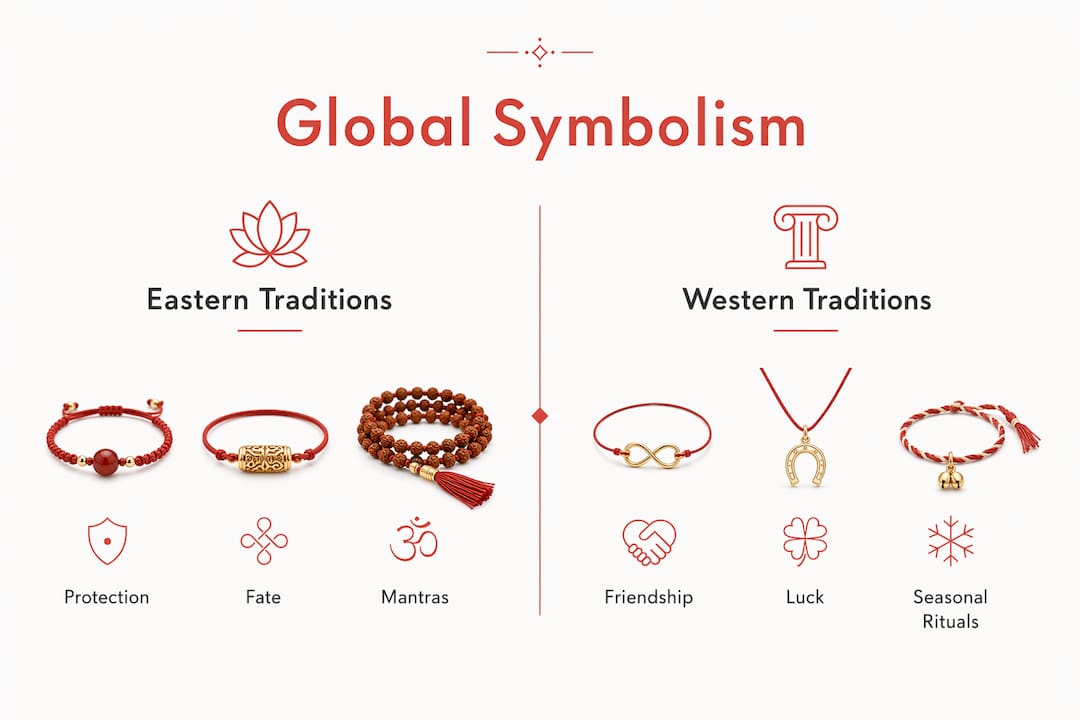
In Kabbalah, the left wrist receives the red string because the left side is considered the body’s receiving channel. The string wards off the evil eye and is tied by someone else, never by the wearer alone. In Hindu custom, wrist placement shifts by gender and occasion. During Raksha Bandhan, sisters tie threads on brothers’ right wrists. During certain temple rituals, priests tie sacred threads on the right wrist of both men and women as a blessing seal.
Chinese red string beliefs connect to fate rather than protection alone. The red thread of fate, rooted in Chinese mythology, links two people destined to meet, regardless of time or distance. Red is a universal protective color in string bracelets, but its specific meaning shifts from “ward off evil” in Kabbalah to “seal a destined bond” in Chinese tradition.
The Greek Martis bracelet uses two colors, not one. Red represents life and vitality. White represents purity and the coming light of spring. Together, they mark the seasonal shift from winter to spring, worn from the first day of March until the first swallow appears.
| Tradition | Color | Wrist | Core meaning |
|---|---|---|---|
| Kabbalah | Rood | Left | Protection from evil eye |
| Hindu (Raksha Bandhan) | Red or gold | Right | Bond between siblings |
| Chinese red string | Rood | Either | Fate and destined connection |
| Greek Martis | Red and white | Either | Spring renewal and communal identity |
| Friendship bracelet | Any | Either | Lasting bond and shared wish |
- Kabbalah: Protection, tied by another person, left wrist only
- Hindu: Blessing and bond, tied by a priest or family member
- Chinese: Fate, love, and connection between destined individuals
- Greek Martis: Seasonal cycles, communal heritage, and nature’s renewal
- Friendship bracelets: Personal commitment, worn until natural breakage signals wish fulfillment
What is the ritual logic behind tying and wearing string bracelets?
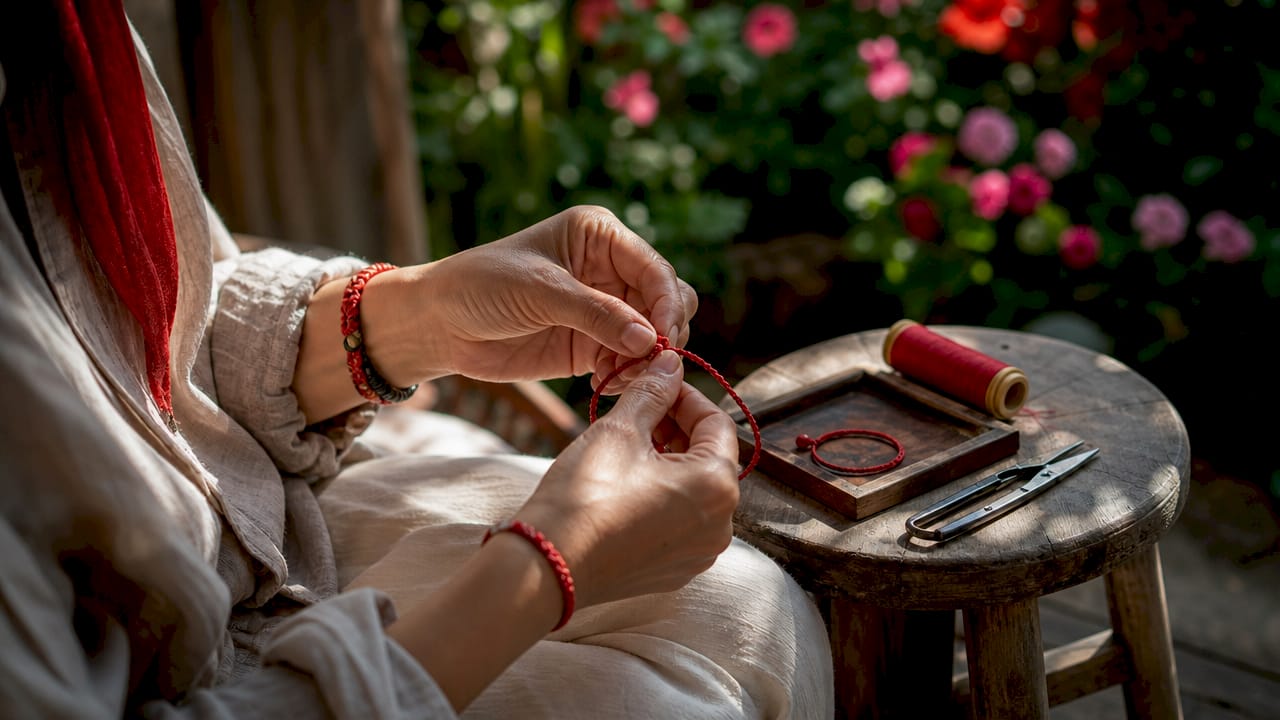
The knot is not decorative. In Tibetan Buddhism and Kabbalah, knots physically seal mantras and protective energy into the cord. The act of tying is the ritual. The bracelet is the residue of that ritual, carried on the body after the ceremony ends.
Rituals involving string bracelets often include chanting, mantra recitation, or controlled breath to imbue the thread with spiritual energy during knotting. This means the bracelet you wear is not just a reminder. It is a container. The intention spoken or breathed during tying is sealed inside the knot and released slowly as the bracelet wears down.
The wrist itself matters. The wrist acts as a threshold where internal life and outward action meet. Every gesture you make passes through the wrist. Placing a protective or intentional symbol at that threshold means the symbol participates in every action you take throughout the day.
“Each time the wrist with the red string is seen, it renews the wearer’s protective boundary and intention.”
That renewal is not passive. Seeing the bracelet during a stressful moment, a decision, or a greeting is a micro-ritual. It pulls the original intention back into conscious awareness. This is why bracelets serve as connections to cultural past and spiritual awareness, not just fashion accessories.
Pro-tip: If you receive a string bracelet as a gift or blessing, let it break naturally rather than removing it. In many traditions, the natural breakage signals that the intention has been fulfilled.
How do artisan-made string bracelets differ symbolically from mass-produced ones?
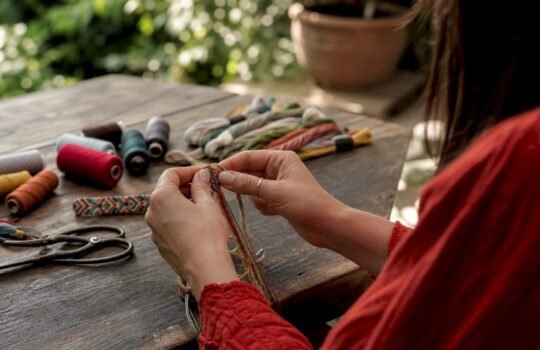
Artisan-made string bracelets contain micro-decisions impossible to replicate by industrial processes. The tension of each knot, the choice of color sequence, the slight variation in braid width: these reflect the maker’s attention and time. That human presence is part of what makes the object meaningful.
Mass-produced bracelets are uniform by design. Uniformity is efficient, but it strips the object of the maker’s gesture. When you wear an artisan piece, you wear someone’s time and care. That is a fundamentally different relationship with an object than wearing something stamped out by a machine.
Imperfections in artisanal bracelets are markers of time and care, not flaws. A slightly uneven knot, a thread end tucked by hand: these are evidence of a human being who made choices. In heritage preservation, that evidence matters. Artisan bracelets carry the logic of their tradition in their construction. A machine cannot replicate the knowledge embedded in a hand-tied Kabbalah knot or a Martis braid.
- Intention: Artisan pieces carry the maker’s focus; mass-produced pieces carry none
- Imperfection: Handmade variation signals authenticity; machine uniformity signals commodity
- Cultural transmission: Artisan techniques pass down generational knowledge; factories do not
- Symbolic weight: A hand-tied bracelet given as a gift holds relational meaning that a packaged bracelet cannot match
This is why artisan bracelets tell richer cultural stories. The object itself is evidence of the tradition it represents. You can learn about symbolic jewelry and its meaning by studying how handmade pieces differ from their commercial counterparts.
What are some symbolic bracelet designs and practices in modern culture?
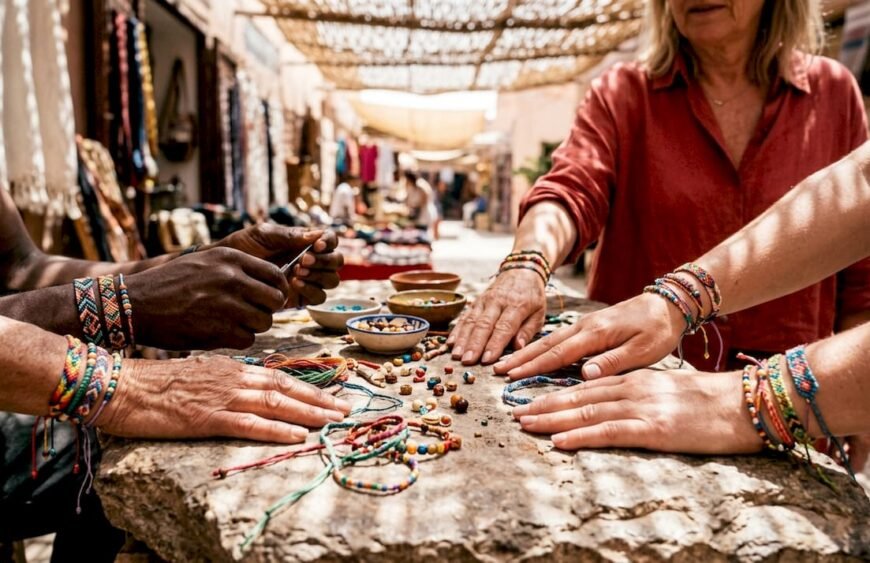
Modern culture has not abandoned thread bracelet symbolism. It has adapted it. Friendship bracelets represent a commitment and bond intended to last until the thread breaks naturally. That practice is ancient in logic, even when the bracelet is made at a summer camp or traded at a concert.
The Greek Martis tradition offers one of the most specific modern examples. The bracelet is worn from the first day of march. When the first swallow of spring appears, the bracelet is thrown onto a rosebush to be woven into nests. The ritual connects the wearer to nature’s cycles and to every generation that performed the same act before them. That is not nostalgia. That is living cultural practice.
- Friendship bracelets: Exchanged as pledges of loyalty, worn until natural breakage signals the wish is granted
- Baba Marta (Bulgarian tradition): Red and white Martenitsa bracelets worn in march to welcome spring, tied to trees when the first stork or swallow appears
- Kabbalah red string: Worn continuously as a protective talisman, tied by a trusted person
- Hindu sacred thread: Tied during Raksha Bandhan and temple ceremonies as a blessing seal
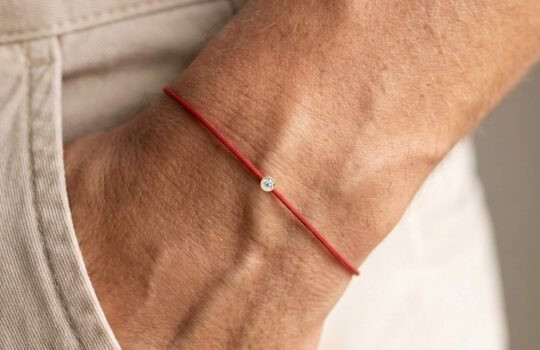
- Modern spiritual fashion: Red string bracelets worn as personal talismans, often layered with diamanten string armbanden for a contemporary look
| Practice | Region | Season or occasion | Symbolic act |
|---|---|---|---|
| Martis bracelet | Greece, Balkans | March 1 to first swallow | Thrown onto rosebush for birds’ nests |
| Baba Marta | Bulgarije | March 1 | Tied to tree when stork appears |
| Raksha Bandhan | India | Late summer | Sister ties thread on brother’s wrist |
| Friendship bracelet | Global | Any | Worn until natural breakage |
| Kabbalah red string | Global | Any | Tied by another, worn continuously |
Belangrijkste punten
String bracelet symbolism across cultures is defined by ritual logic, intentional knotting, and the wrist as a threshold where protection and identity meet.
| Punt | Details |
|---|---|
| Origins span millennia | Chinese knotting from 481–221 BC and Greek Martis traditions show thread bracelets predate modern fashion by thousands of years. |
| Meaning shifts by culture | The same red thread signals protection in Kabbalah, fate in Chinese tradition, and seasonal renewal in Greek custom. |
| The knot seals intention | In Buddhist and Kabbalah practice, knots physically contain mantras or blessings spoken during tying. |
| Artisan pieces carry more weight | Handmade bracelets embed the maker’s time and care, making them culturally richer than mass-produced alternatives. |
| Modern practice stays alive | Traditions like Martis, Baba Marta, and Raksha Bandhan remain active cultural rituals, not historical relics. |
Why string bracelets still matter more than people realize
Most people treat a string bracelet as an afterthought. I think that is a mistake, and I’ve spent enough time studying symbolic jewelry to say it with confidence.
What strikes me most is the ritual logic. The bracelet is not the symbol. The act of tying it is the symbol. The bracelet is just the proof that the act happened. When you understand that, you stop looking at a red thread as a fashion choice and start seeing it as a portable ceremony. That shift in perspective changes how you wear it and how you give it.
The artisan question is where I feel most strongly. A machine-made bracelet is a product. A hand-tied bracelet is a gesture. Those are not the same thing, and the difference shows up in how the object feels to receive and to wear. Imperfection is not a quality problem. It is the signature of a human being who paid attention.
The modern adaptation of these traditions is also underrated. The Greek Martis bracelet is still thrown onto rosebushes. Bulgarian families still tie Martenitsa in march. These are not museum pieces. They are living rituals that connect people to something larger than their daily routine. Wearing a string bracelet with that awareness makes it a completely different object than wearing one without it.
— Danielius
Artisan string bracelets with cultural meaning at Jewelsbyares
Jewelsbyares designs string bracelets that honor the traditions covered here. The red thread bracelet collection draws directly from Kabbalah and East Asian symbolism, crafted with the same intentional knotting logic that defines those traditions. For those who want to layer meaning with luxury, the diamond string bracelet collection combines certified diamonds with hand-tied cord, merging ancient symbolic form with modern elegance. Every piece is artisan-crafted using ethically sourced materials, ships worldwide in gift-ready packaging, and is designed to be worn as a personal talisman, a meaningful gift, or a daily reminder of something that matters.
FAQ
What does a red string bracelet symbolize?
A red string bracelet symbolizes protection, luck, and connection, with the specific meaning varying by tradition. In Kabbalah it wards off the evil eye; in Chinese belief it marks a destined bond between two people.
Which wrist should a string bracelet be worn on?
Wrist placement depends on the tradition. Kabbalah practice specifies the left wrist as the body’s receiving side, while Hindu Raksha Bandhan threads are tied on the right wrist.
Why do friendship bracelets break naturally?
Friendship bracelets are worn until the thread breaks because natural breakage signals that the wish or bond made at tying has been fulfilled. Removing the bracelet intentionally is considered to break the intention prematurely.
What is the Greek Martis bracelet tradition?
The Martis bracelet is a red and white thread bracelet tied on march 1 and worn until the first swallow of spring appears. It links to the ancient Eleusinian Mysteries and has survived thousands of years of cultural change.
How is an artisan string bracelet different from a mass-produced one?
Artisan bracelets carry the maker’s intention through hand-tied knots and deliberate material choices. Imperfections in artisanal bracelets are markers of care, not defects, making each piece a culturally distinct object rather than a commodity.