

TL;DR :
- The red thread is a universal symbol of protection, fate, and connection across many cultures. It signifies unbreakable bonds, spiritual protection, and personal intent, often worn as bracelets or tied during rituals. Its meaning is amplified by the color red’s association with life, passion, and energy, making it a powerful and enduring talisman.
The red thread is defined as a universal symbol of protection, fate, and vital life force, recognized across dozens of cultures and spiritual traditions worldwide. Ask what does red thread symbolize in any corner of the globe, and you will find a consistent answer: connection. Whether tied around a wrist, knotted with intention, or woven into a bracelet, the red thread carries meaning that predates written history. From East Asian folklore to Kabbalistic ritual, Hindu ceremony, and Buddhist practice, this simple cord holds extraordinary symbolic weight. Understanding its origins helps you wear it with purpose.
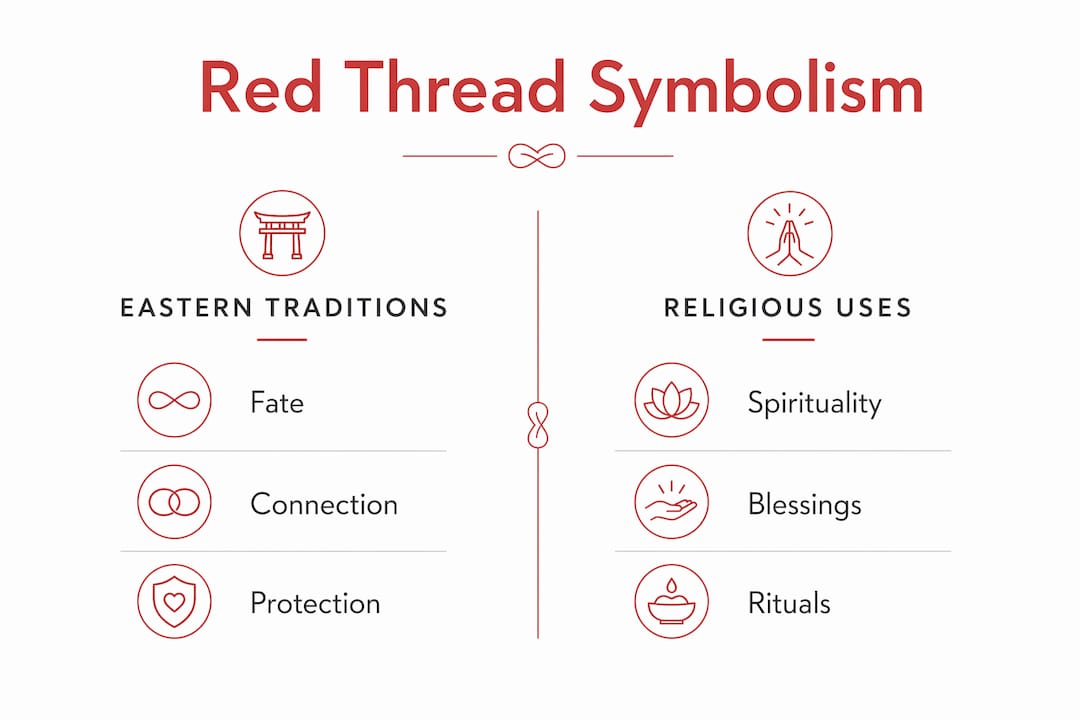
What does the red thread represent in East Asian traditions?
The Red Thread of Fate is the oldest and most widely recognized form of red thread symbolism. Rooted in East Asian folklore, it describes an invisible cord tied between two people who are destined to meet and shape each other’s lives. The thread connects their fingers or ankles and cannot be broken, no matter how tangled or stretched it becomes.
“The red thread of fate may stretch or tangle, but it never breaks. Two people bound by it will always find their way to each other, regardless of time, place, or circumstance.”
This concept originated in Chinese mythology, where the lunar deity Yue Lao ties the thread between future partners. Japanese tradition adopted the same idea, calling it unmei no akai ito, meaning the red thread of fate. Both cultures treat the bond as absolute and preordained.
The symbolism has expanded well beyond romantic love. Modern interpretations include:
- Deep friendships that feel fated rather than chosen
- Mentor and student relationships that define a person’s path
- Family bonds that persist across distance and conflict
- Chance encounters that redirect the course of a life
The red thread of fate also carries a subtle but important truth: the thread can tangle. That detail matters. It acknowledges that meaningful relationships are not always smooth. They require patience, effort, and forgiveness. The image of a knotted thread is not a sign of failure. It is a sign of depth.
How is the red thread used in religious and spiritual traditions?
Across South Asia, the Middle East, and Tibetan Buddhism, the red thread appears in ritual contexts with a shared purpose: protection and divine connection. Each tradition gives it a distinct name and method, but the core meaning of red thread remains consistent.
Hindu Mauli or Kalava thread. Hindu priests tie a red or red-and-gold thread around a devotee’s wrist during religious ceremonies. The Mauli thread represents divine protection and serves as a physical reminder of spiritual intention. It is tied on the right wrist for men and the left for women, following Vedic convention.
Kabbalistic red thread. In Kabbalah, a red wool thread is worn on the left wrist to ward off the evil eye. The left side of the body is considered the receiving side, making it the correct placement for a protective talisman. The thread is typically brought from Rachel’s Tomb in Israel, adding a layer of sacred geography to its power.
Tibetan Buddhist red thread. Tibetan lamas bless silk red threads and tie them around the wrists of practitioners. These threads are believed to balance energies and carry the lama’s protective intention into daily life.
Latin American traditions. In several Latin American cultures, red thread bracelets are tied on newborns and young children to protect them from the evil eye, known locally as mal de ojo. The practice blends Indigenous and Catholic spiritual beliefs.
The common thread across all four traditions, literally and figuratively, is the idea that a physical object can hold spiritual power. The act of tying creates a boundary between the wearer and harm.
Conseil de pro : If you wear a red thread for spiritual reasons, research the specific tradition you are drawing from. Each has its own tying method, wrist placement, and intention-setting practice. Wearing it with knowledge deepens its meaning.
Why does the color red amplify the thread’s symbolic power?
Red is the most emotionally charged color in the human visual spectrum. Red symbolizes life force, courage, passion, and auspiciousness across cultures spanning from ancient cave rituals to modern spirituality. That history is embedded in every red thread you see on a wrist.

The color carries a dual nature that makes it uniquely powerful as a symbol. On one side, red represents blood, fire, and vitality. On the other, it signals danger, intensity, and warning. This duality is not a contradiction. It is the source of the color’s strength.
| Symbolic dimension | What red represents | How it applies to the thread |
|---|---|---|
| Life force | Blood, heartbeat, energy | The thread as a living bond between people |
| Protection | Fire, boundaries, warning | The thread as a shield against harm |
| Passion | Love, desire, commitment | The thread as a marker of deep connection |
| Auspiciousness | Luck, celebration, blessing | The thread as a talisman for good fortune |
Red’s dual symbolism of life and destruction enriches the red thread’s psychological impact. It is both protective and empowering at the same time. That combination is rare in symbolic objects, and it explains why the red thread has survived across so many cultures and centuries without losing its resonance.
Conseil de pro : When choosing a red thread bracelet, pay attention to the shade. Deep crimson reads as protection and power. Bright scarlet reads as energy and passion. Both are valid. Choose the one that matches your intention.
What rituals and practices give the red thread its meaning?
The physical act of tying the red thread is not incidental. The ritual itself is part of the meaning. Practitioners tie exactly seven knots in red thread bracelets, with each knot holding a specific protective intention rooted in Kabbalistic practice. Seven is a number of completion in many spiritual traditions, and each knot seals a layer of protection into the cord.
The red thread also functions as what scholars describe as a symbolic umbilical cord. It connects the wearer to their origins and grounds them spiritually, much like the mythological thread of Ariadne guided her through the labyrinth without losing her sense of self. The thread does not just protect from outside forces. It anchors you to your own identity.
Ritual practices vary by tradition, but several elements appear consistently:
- The thread is tied by another person, not by the wearer, to transfer protective intention
- The knot is made while reciting a prayer, blessing, or specific intention
- The thread is worn until it falls off naturally, which is interpreted as the protection being complete
- Some traditions require the thread to be buried or burned after it falls off, not simply discarded
Le tangled or knotted red thread also carries its own meaning as a metaphor. Meaningful human relationships involve complexity, challenges, and growth. A perfectly straight thread represents a simple connection. A knotted one represents a real one.
| Ritual element | Traditional meaning |
|---|---|
| Seven knots | Layered protection, spiritual completion |
| Tied by another person | Transfer of intention and care |
| Left wrist placement | Receiving side of the body, open to protection |
| Natural removal | Protection fulfilled, cycle complete |
How is red thread symbolism applied in modern jewelry?
The red thread has moved well beyond its religious origins. Modern wearers use the thread as a personal talisman rather than strictly for traditional religious reasons. This shift reflects a broader trend toward personal spirituality, where individuals select symbols that resonate with their own values and experiences.
Red thread bracelets now serve several distinct purposes in contemporary life:
- As a daily mindfulness tool, the bracelet acts as a physical prompt to return to a chosen intention
- As a gift between close friends or partners, it marks a bond and carries the giver’s protective wish
- As a fashion piece, it layers with other bracelets to add color, texture, and personal meaning
- As a grief or healing object, it provides a tangible anchor during difficult transitions
The red thread as a spiritual anchor is evolving, shifting from strictly religious use to a personal tool for mindfulness and strength. That evolution has made it more accessible, not less meaningful. Many people who wear red thread bracelets today do so with full awareness of the traditions behind them, choosing to honor that history while adapting it to their own lives.
Jewelsbyares designs red thread bracelets that sit at exactly this intersection. Each piece combines traditional symbolism with modern craftsmanship, making the meaning wearable every day. You can also explore thread bracelet color meanings to understand how red compares to other colors in the symbolic spectrum.
Points clés à retenir
The red thread is one of the most universally recognized symbols of protection, fate, and human connection, drawing power from both ancient ritual and the primal psychology of the color red.
| Point | Détails |
|---|---|
| Universal symbol | The red thread represents protection, fate, and vitality across dozens of cultures worldwide. |
| East Asian origin | The Red Thread of Fate describes an unbreakable bond between destined souls, not only romantic partners. |
| Religious significance | Hindu, Kabbalistic, Buddhist, and Latin American traditions all use red thread for protection and spiritual focus. |
| Ritual power | Seven knots, left wrist placement, and intention-setting are the core ritual elements that activate the thread’s meaning. |
| Modern relevance | Red thread bracelets now function as personal mindfulness tools and meaningful gifts beyond their religious roots. |
The red thread never really goes out of style
I have spent years studying symbolic jewelry, and the red thread is the one object that consistently surprises me. Most symbols fade when they leave their original context. The red thread gets stronger. Every tradition that adopts it adds a new layer of meaning without erasing the ones before.
What strikes me most is the psychological honesty built into the symbol. The thread can tangle. That detail, present in the original East Asian legend, is what separates the red thread from sentimental clichés. It does not promise a perfect connection. It promises a real one. That is a far more useful thing to carry on your wrist.
Psychologists recognize the “fil rouge” metaphor as a tool for visualizing life continuity, connecting relationships and experiences into a coherent story. That is not a coincidence. The red thread works as a symbol because it maps onto something true about how human beings actually experience connection. It stretches. It knots. It holds.
If you are considering a red thread talisman, I would encourage you to choose one with full awareness of its history. The meaning is not diminished by crossing cultural lines. It is enriched by understanding where those lines come from.
— Danielius
Red thread bracelets crafted with intention at Jewelsbyares
The symbolism of the red thread deserves a piece that honors it properly. Jewelsbyares handcrafts red thread and string bracelets using premium, ethically sourced materials, combining the weight of tradition with the precision of modern jewelry making. Each bracelet is designed to be worn daily, layered with other pieces, or given as a meaningful gift at a milestone moment. The collection spans minimalist single-strand designs to woven multi-layer compositions, giving you full control over how you carry the symbol. Every piece ships worldwide in elegant, gift-ready packaging. If you are ready to wear your intention, the collection is waiting.
FAQ
What does the red thread symbolize in Chinese culture?
The red thread symbolizes an unbreakable bond of fate between two people destined to meet. In Chinese mythology, the lunar deity Yue Lao ties this invisible thread between future partners, and it cannot be severed regardless of distance or circumstance.
Which wrist should you wear a red thread bracelet on?
The left wrist is the traditional placement, particularly in Kabbalistic practice. The left side of the body is considered the receiving side, making it the correct location for a protective talisman.
How many knots does a red thread bracelet have?
Traditional red thread bracelets contain exactly seven knots. Each knot holds a specific protective intention, a practice rooted in Kabbalistic ritual that represents spiritual completion and layered protection.
What is the difference between the Hindu Mauli thread and the Kabbalistic red thread?
The Hindu Mauli thread is tied during religious ceremonies as a reminder of spiritual intention and divine protection, while the Kabbalistic red thread is worn specifically to ward off the evil eye. Both use red thread as a protective talisman, but their ritual contexts and tying methods differ.
Can anyone wear a red thread bracelet?
Yes. While the red thread originates in specific religious traditions, its use has expanded into personal spirituality and mindful jewelry wearing. Wearing one with awareness of its cultural roots is the most respectful approach.
Recommandé
- Pourquoi un bracelet en fil rouge et or a plus de signification que vous ne le pensez – Jewels By Ares
- Signification des couleurs des bracelets en fil : votre guide complet
- La symbolique du bracelet en ficelle à travers les cultures : un guide complet
- Signification des bracelets en cordons offerts en cadeau : ce que symbolise chaque couleur